

Year-end musings
A compilation of thoughts swirling in my head that couldn't be converted into individual posts.

Dearest Reader,
The urgency of the year-end has blown me away, and my fingers now act on their own accord—click-clacking their way as December has arrived at breakneck speed. Breakneck, yeah, that’s exactly how this year has felt: gone with the wind.
Did you feel this way too?
With this being my first year of genuinely channeling the tennis writer-storyteller persona, I’ve learned to develop a more discerning eye, one that tries to take into account a myriad of perspectives while also sifting through the noise. I thought I’d take you through to the other side when the fog begins to clear.

1.) Starting off strong, somewhere mid-year, I came to this realization: tennis and writing are suprisingly alike. Both quintessentially require that you spend a lot of time by yourself. You pause to understand what worked and what didn’t in your game as you learn and experiment. Similarly, you try your hand at different write-ups and coalesce ideas from various mediums as you set out to find your natural voice. Then you go out there and put on a show! Some matches you lose, just like some posts flop. You’re dismayed for a bit, but soon realize the clock is ticking, and wallowing in this self-inflicted pity is worse than a flop. Therefore, the show must go on.
As recluse-prone as tennis players and writers can sometimes be, the truth is it takes an army to raise them. Without the constant reassurance and guidance of everyone on their teams—physios, coaches, trainers, hitting partners, families, and friends—tennis players would be lost at sea, barely afloat, deferring their inevitable drowning. In a similar vein, writers latch onto their fascinations—whether tangible or intangible—and evolve with the ebbs and flows. All the world’s their stage. Their empathy resounds across time; no topic is off-limits, no realm too deep to explore. It all becomes their battalion.
Precision, passion, and foresight become the defining triad of both these wildly riveting creatures, propelling them to retrieve backhands and ideas that seem unreachable to those inexperienced.
Yet another striking similarity is that they can both become hostages of their own minds. Tennis players obsess over a missed shot, replaying it in loops until it consumes them. Writers get trapped in cognitive snares, second-guessing every word, every phrase, every nuance. Their inner critics can be relentless, whispering that they’re never good enough, even when evidence suggests otherwise. It takes both keen awareness and a touch of stubbornness to release the chains we place on ourselves and slip back into the flow.
They both live with filaments of delusion running through their veins; for delusion, in healthy doses, is audacious. It’s the fuel that sustains them against all odds.
In this record-shattering game of life, the final-set tiebreaker they’re embroiled in never truly ends. How could it? Passions don’t come with an expiration date. Whether it’s tennis or writing — or, if you’re like me, both — they grab a hold of you one day and refuse to let go. And those I-get-to-live-with-these- memories, the ones earned through trying, will always outlast the hollow echo of I-wish-I’d-given-it-a-shot.

2.) This next musing is a shorter one, but we have to discuss the World Cups of tennis—the Davis Cup and the Billie Jean King Cup. Both have undergone numerous rebrands since their inception, yet their importance on the calendar has, to some extent, steadily diminished. When I take the term “World Cup” at face value, I’m immediately reminded of prestige, rarity, and high-spiritedness. In cricket, the T20 World Cup is biennial, held every other year; the ODI World Cup is quadrennial, held every four years. Similarly, in football, the FIFA World Cup follows that same four-year cycle.
Tennis, being an individual sport of its stature, faces its own structural complications since there’s no unified governing body dictating a singular vision. Squeezed into an already overcrowded calendar, these tournaments compete with Masters 1000s, the ATP Finals, and the season’s final push for ranking points. Many top players routinely skip them, prioritizing individual success over national duty; and it’s hard to fault them when they’re physically exhausted from a gruelling season.
The only unique incentive the Davis Cup offers is that it’s mandatory for Olympic eligibility. But here’s the catch: players don’t need to participate every year to remain eligible, which is precisely why top players show up sporadically, just enough to tick the box. Yet for those who do commit, the motivation runs deeper than any tangible reward. Playing for your country, sharing the pressure and triumph with teammates in a sport that’s otherwise brutally solitary. Here, they find camaraderie and collective purpose that can’t be replicated elsewhere.
This led me to wonder would a revamp be worth considering? Could shifting to a biennial or quadrennial model augment their prestige, restoring the gravitas the “World Cup” title implies? Scarcity breeds value, so imagine if players circled these events on their calendars years in advance, if national pride became the centerpiece rather than an afterthought squeezed into an already overcrowded season. Or would tampering with tradition risk diminishing what reverence remains? Could it alienate purists who still remember when Davis Cup weekends genuinely mattered? The tension between honoring history and adapting for relevance has never been more pronounced, and tennis must decide: does it want a World Cup in name only, or one that truly matters?

3.) Number 3 has had me yelling: “Did You Fall Down And Smack Your Little Head On The Pavement?”, for a few years straight. Just like merely witnessing everyone’s outfits, (actually existence) was a tragic burden Miranda Priestly felt afflicted by, I, too, feel personally inconvenienced by the downfall of tennis fashion.
With every passing tournament, the cumulative effort seems to be draining. The majority of the outfits are lacklustre and forgettable with morbidly hideous colour schemes *cue Alcaraz’s neon fit at the Paris Masters; dressing Jannik Sinner up as Luigi at Roland Garros; Nike’s bib-like dress for the Australian Open in a gloomy teal and yellow; Adidas’s poorly abstracted Y-3 US Open collection with haphazardly splattered browns; or Ons’ collection that looked like using MS Paint for the first time after which the printer ran out of ink mid-job and just gave up entirely.*
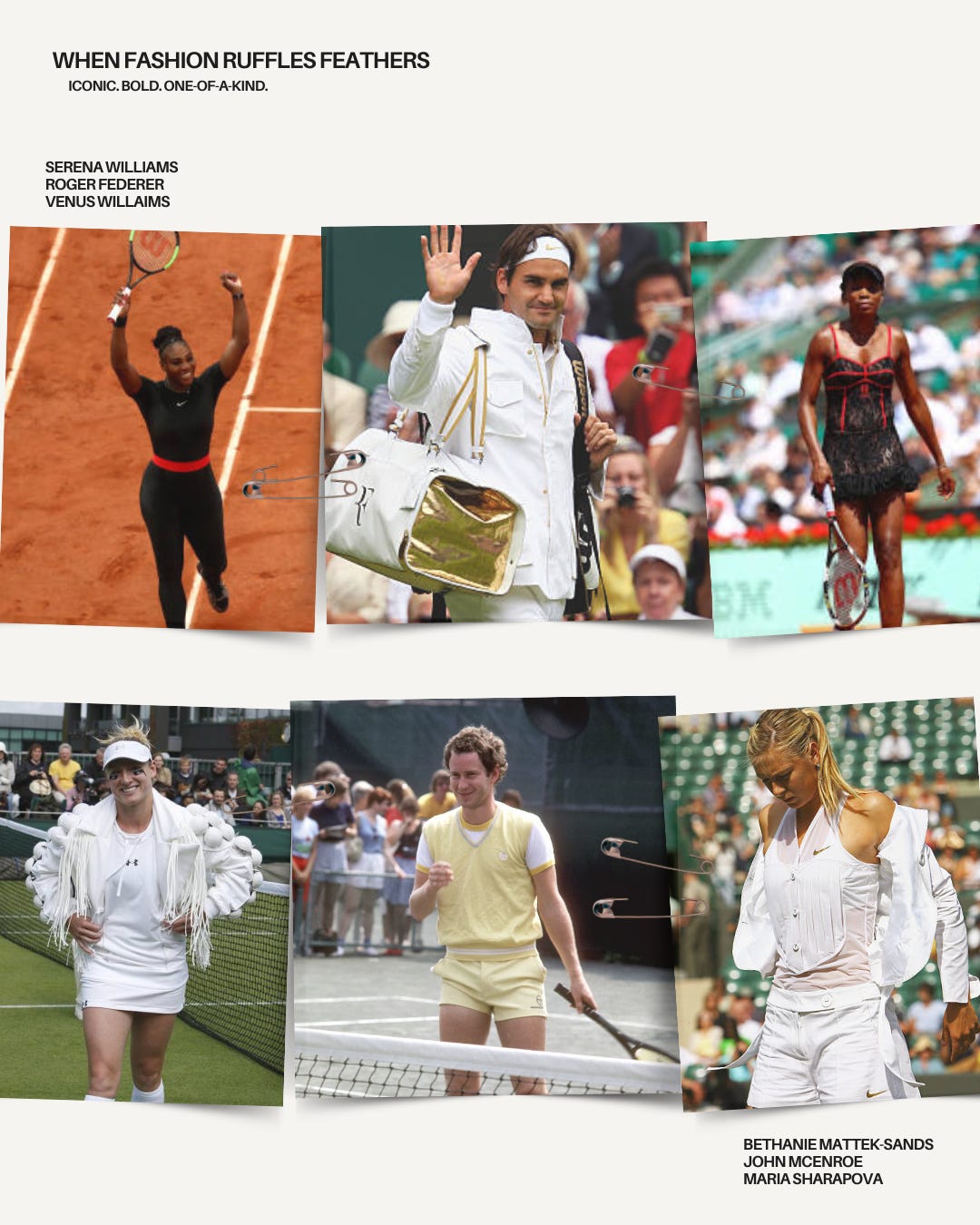
Like it or not, but a notable and mesmerizing part of Tennis has invariably been its outfits.Fashion has always captured the cultural zeitgeist, driving change while giving voice to self-expression. Serena Williams’s catsuit, Roger Federer’s Military-style jacket, Venus William’s Moulin Rouge inspired lacey dress, Bethanie Mattek-Sands’ Gaga look, Maria Sharapova’s tuxedo-inspired look, or John McEnroe’s buttercup yellow are are among the iconic, debate-sparking outfits.
Take Andre Agassi, for example, whose metamorphosing hairstyles and outfits defined an entire generation of watchers. His neon rebellion and denim shorts were pivotal moments that challenged tennis’s conservative establishment. Not everyone might have tried to outrightly emulate him, but his looks stamped an imprint in their minds and still resonate in sports fashion conversations.
Today, heritage athleisure brands like Nike and Adidas seem to be dragging their feet, hesitant to commit to the very sport they once dominated.
Nike has been the frontrunner for tennis fashion with its elite lineup.
Always winning. Always stealing the show. Always going the extra mile.
Under their reign, personalised outfits for their champions soared, but now they’ve nosedived from the scene. I’d reckon, now more than ever, they need to up their game because tennis and tennis fashion are having a genuine cultural moment, yet Nike seems on the fence. But their hesitance goes beyond stylistic choices. Retaining players is not a game Nike is interested in playing— they fumbled Roger Federer afterall. Keeping with this trend, they continue to hemorrhage top names faster than you can say “swoosh.”
If I were Priestly, details of their incompetence wouldn’t interest me; But I’m not, so pray tell, why the conspicuous disinterest?
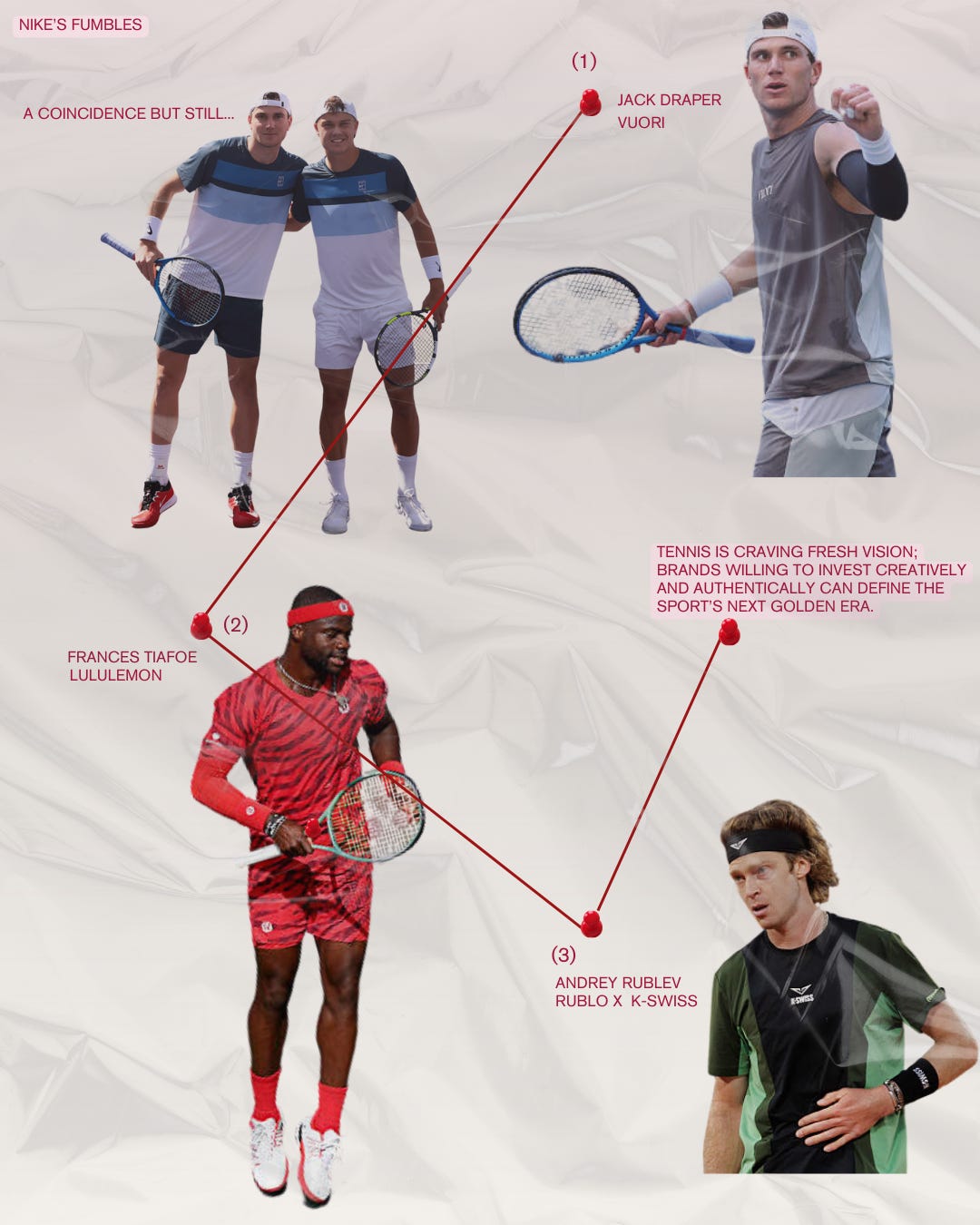
For example, Jack Draper started the year with Nike, won Indian Wells wearing them too, and also managed an awkward same outfit run-in with finalist Holger Rune. Twinning outfits for a final? Groundbreaking. He jumped ship to Vuori (an American contemporary clothing brand) by the time the US Open came around. Similarly, Nike lost out on Frances Tiafoe, who joined hands with Lululemon. At the US Open, he walked out in a red monochromatic animal-print kit that beautifully complemented his forward and energetic style. Andrey Rublev, too, was dropped and went on to start his own brand—Rublo—, and frankly, he looks more dapper than ever. I also love Rublev’s commitment to making a difference in the lives of the next generation, as his inaugural collection titled “Play for the Kids” sees 100% proceeds go to children’s welfare.
Naomi Osaka remains the exception, the only player Nike seems to truly invest in anymore. Fair play to them because she is a four-time grand slam champion whose looks alone can set the tennis world buzzing. At the USO this year, Osaka dazzled in glitter-studded outfits. A red look, for the night session, and a lilac one, for the day session matches. She went the extra mile by going all out from head-to-toe with glitter roses cascading down her hair. And just when you thought the bedazzling had reached its peak, she revealed punny glittery Labubus named Andre Swagassi and Billie Jean Bling, amongst others.
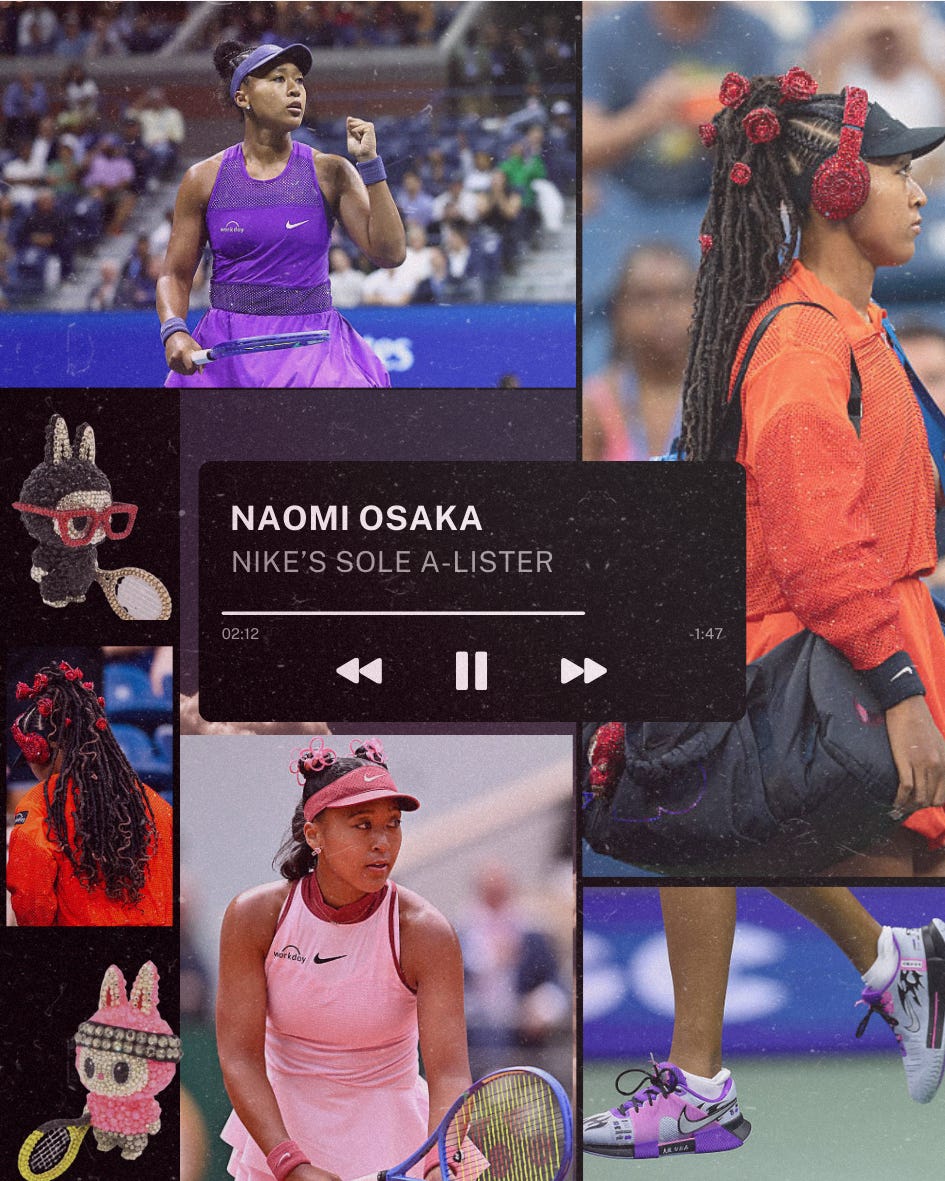
I promise you, dear reader, Labubus as a fashion statement would have Miranda Priestly removing her glasses slowly, fixing you with that withering stare, and saying, “I see. You’ve decided that stuffed toys are the future of haute couture. Truly visionary. When you’re done revolutionizing fashion with...plush demons, do let me know.”
Quick question: Are any of you seriously into them? What’s the appeal?
Well, speaking of brands stealing the show, Wilson leads the charge. The brand has gained sizeable traction for the way it dresses Ukrainian powerhouse Marta Kostyuk, their hero athlete. In 2025, Kostyuk has delivered look after look. A fiery red ensemble at the Australian Open that stood out even in a sea of reds this year. Followed by two seamless ombrés: first, a romantic lavender-to-soft dusty-rose gradient—a kit fit for tennis paradise; and second, a royal blue wash that moves from rich cobalt to a brighter, watercolor-like hue, a stunning tune-up to the Flushing Meadows Fashion Week. Kostyuk’s fingerprints are unmistakably on each piece as her involvement in the R&D process is evident in the harmony between aesthetic ambition and performance practicality.
But Wilson’s sartorial brilliance doesn’t end with its flagship star. The brand is also investing in the next wave of talent, including Victoria Mboko and Alycia Parks. At the French Open, in striking sunset yellow, Mboko wore a cropped polo with crisp, fluttering pleats, a silhouette that blends classic tennis elegance with a modern edge.
Wilson is placing tennis fashion squarely between memory and momentum, unafraid to lead and make the most of the sport’s resurgent spotlight.
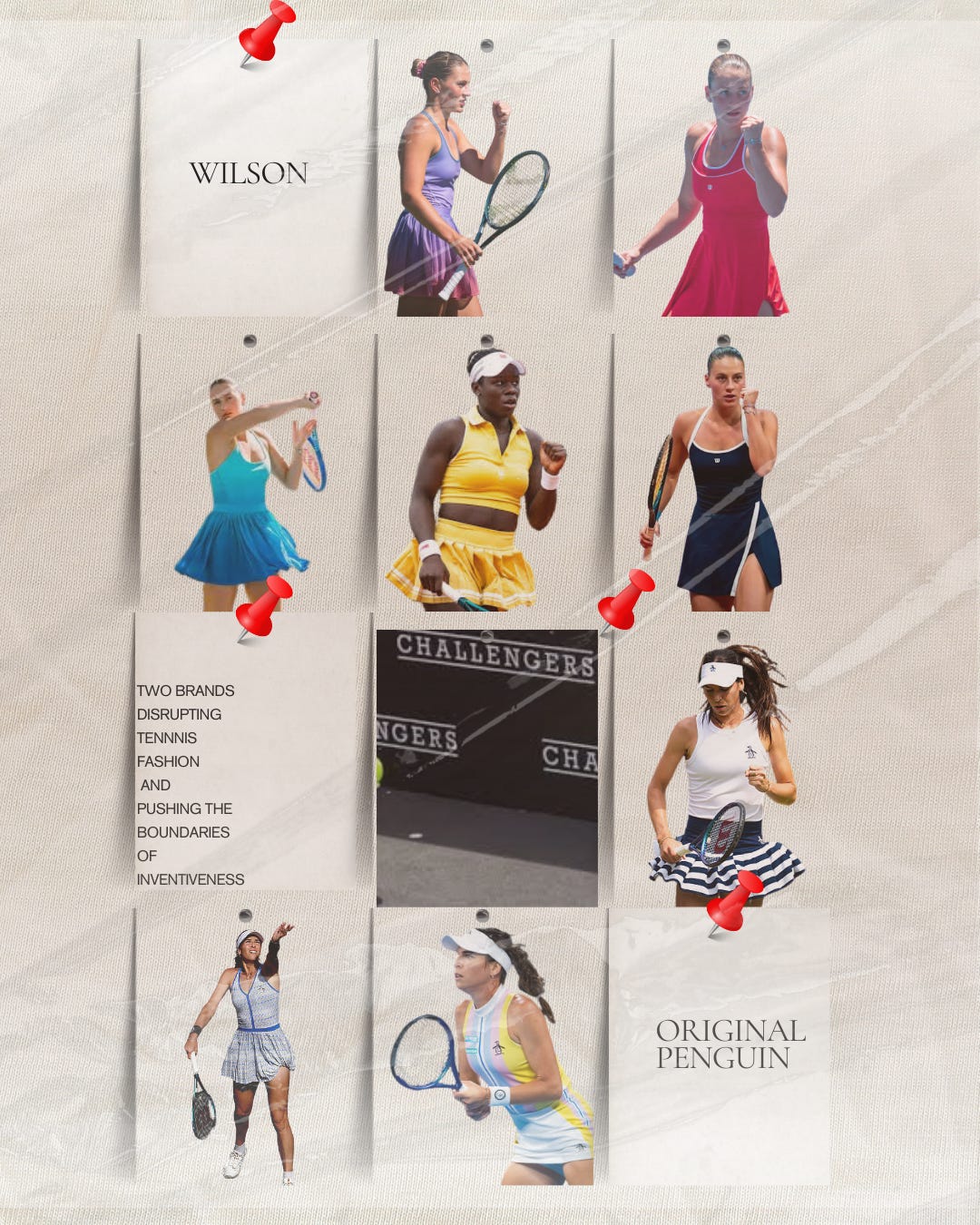
Another show-stopper, for me, would be Original Penguin, an American clothing line flying under the radar. In 2022, they signed Australian Ajla Tomljanovic as their first tennis brand ambassador, and together, they’ve been keeping alive a strain of tennis fashion that thrives on innovation without sacrificing utility. This year, at her home slam, she donned a pastel vertical striped outfit— a refreshing nod to the breeziness of the Australian summer and hands down my favourite look of the year.
Another outfit that caught my eye was a nautical-inspired one. A sleeveless white tank top with a tiny penguin logo on the chest, worn with a pleated tennis skirt in bold navy and white horizontal stripes that created a fun maritime aesthetic. I find that Original Penguin’s originality cuts through the market’s suffocating sameness like a sudden, life-saving breath.
Both these brands have understood that the time is now. If they can keep their wheels of creativity spinning throughout the year, it will be only a matter of time before a swarm of players want to be on board.
A section on fashion without mentioning Coco Gauff, is frankly, self-incriminating. Gauff has cemented herself as a fashion-forward player, who brings vibrant colors, bold patterns, and modern silhouettes to the court that reflect her confident personality. Her New Balance collections have been all the rage this year.
In an interview, she revealed,
“When I curated the tennis pieces, I made sure they not only matched the aesthetic, but also felt true to me. It’s important…for different demographics to feel represented because sometimes in high fashion that’s missing, [and] I wanted my selection to reflect that.”1
Truly, her kindness and sensibility never fail to leave me in awe.

Off the court, she exudes equal glamour. This year, Gauff captivated onlookers at the Academy Awards in a custom Miu Miu soft buttercup yellow gown with a plunging V-neckline, a dramatic draped cowl back, and delicate crystal embellishments. Soon after, she was spotted in a lime-green chartreuse (shartrooz) gown with intricate sequin beadwork for the Vanity Fair after party. When it comes to fashion, Gauff can harness the best of many worlds switching from ultra-glam to preppy styles. For her French Open celebration, she wore a tailored navy canvas blouson jacket, a chocolate brown suede mini skirt and platform loafers merging runway-ready elegance with her signature sporty edge.
High heels may be her “kryptonite,” as she’s joked, but Coco Gauff’s stature is undeniable—built on confidence, poise, and championship chops.
To close it out: Fans, like myself, want to see veritable effort. We want to witness riotous passion etched into every design where each outfit serves as a nod to the players, a sign of respect towards the game, and not just soulless pieces churned out on autopilot.
Thats all.
Okay, I lied there’s a last one.
4.) Wouldn’t it be incredible for tennis to not self-sabotage its storytelling abilities? Storytelling is the sport’s pulse. It carries us through triumph and heartbreak, giving meaning to the moments in between. It’s what binds us as an audience, not through spectacle or gossip, but through something real and resonant. Without it, even the most beautiful tennis can begin to feel unmoored, drifting without memory or meaning.
There are now countless mediums designed to wring personality from the game, yet much of it feels muted and strangely repetitive. It’d be great to see content not entirely plagued by the quick dopamine-hit culture that we’ve been seized by. At first this short content sparks. Then, midway through the season, it begins to blur. The questions grow increasingly random, with some being genuinely fun and laugh-out-loud enjoyable, others oddly forsaken, drifting without purpose. What’s meant to reveal personality too often flattens it, leaving us entertained in moments, but rarely moved.
The tennis mediascape is a fragmented ecosystem with multiple parties involved. By the time any of them come close to streamlining their commercial assets and securing their intellectual property rights, it’ll be too late to capitalize on the current opportunity. They could start by loosening their ironclad grip on content restrictions at events. If players cannot share their life on the tour, which is the majority of their year, how are they then expected to increase their visibility and break into newer markets?
I have an idea, and it might sound crazy, but I love the Vanity Fair roundtable concept they do at year’s end with actors and directors. Imagine something like that for tennis. Players, past and present, sit down together for real conversation. It’d be a chance to see the depth that’s always been there, just waiting for someone to ask the right way. Maybe innovation like this could shift how we see these athletes entirely. Not just players but bring out the chair umpires and tournament directors, let them capture the frenetic energy behind the scenes. Give them an hour and give them space to think out loud. Let them disagree, let them laugh, let them be human in a way that thirty-second clips could never allow.
Tennis must re-learn not only how to embrace the spotlight, but how to sustain it and the only credible way forward is to loosen up.
And so I couldn’t help but wonder: in a world hungry for connection, for authenticity, for stories that linger long after the final point is played, can tennis afford to keep its players at arm’s length? Or will it finally realize that the greatest asset it has isn’t the baseline rallies or the championship trophies, but the beating hearts behind them?
Here’s to hoping tennis remembers that we don’t just watch for the winners, we watch for the journey. We stay for the stumbles, the comebacks, the moments that make us feel less alone in our own impossible pursuits, knowing magic is still probable.
I’m excited to see how the 2026 season unfolds, Dear Reader, I hope you are too!
There are maybe two more posts coming your way before the year ends.
Please stay tuned for those.
Thanks for reading or listening.
Until Next Time.
Love-all, always
Areyah
Author’s Note: I truly enjoyed creating this piece and this format with the supporting visuals made it all the more enjoyable! I hope you like this too :)
https://wwd.com/eye/parties/coco-gauff-curated-miu-miu-selection-midtown-party-tennis-1238135494/
Dynamite read! A feast of tennis writing in four parts, the main course for me being the scrumptious third:
A critical commentary on the current state of tennis fashion, flavored with salty and sweet observations of the good and bad.
Compliments to the chef 👌
This was such a lovely read! Would love to see tennis innovate more on storytelling and how they interact with the fans. It's really having a big moment but risks missing it, and you look at a sport like F1 that leaned into that moment, let the fans in, and is reaping the rewards.