

Melbourne Archives
Australian Open's fashion history

Dearest Reader,
Tennis and fashion, like a moth drawn to a flame, will always find each other.
This expression captures my New Year optimism. What rendered this possible, though, was a deep dive into the past. I felt like, if I am going to express opinions on the current state of tennis fashion, they must be rooted in something tangible. And it became important for me to understand what raised the general expectations of us as fans of the game. Here’s my entry on it.
The coalescing of tennis and fashion is a tale as old as time. Anyone who knows me knows that I love Schiaparelli’s creations, so imagine my delight when I found out that Elsa Schiaparelli dressed Spain’s first star player, Lili de Alvarez, in a “divided-skirt”, now known as culottes, for the 51st Wimbledon at the All England Lawn Tennis and Croquet Club (AELTC) in 1931. This collaboration— by two women who refused to be reduced to labels—caused quite a fracas, enraging the Press and dividing the fans. While culottes were looked down upon on the tennis courts, it evolved into a fashion-forward statement piece embraced by many women at the time.
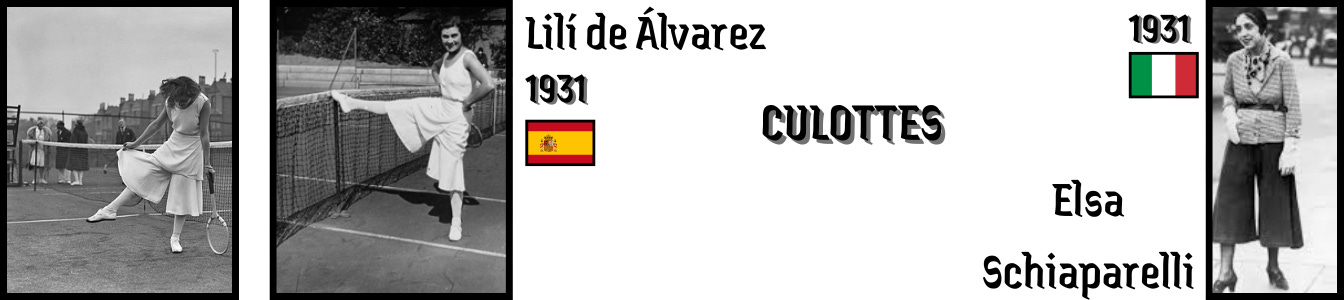
For context, “The Señorita”, as the British press monikered her, was a daring, free-spirited feminist1 who never stayed firmly rooted at the baseline, and her half-volleys sent the tennis world exploding with excitement2. Wait, an aggressive all-court Spaniard? Where have I seen that before… well, I guess we now know the origins :)
This also got me thinking that if I were a tennis player, an impractical thought, then you best believe I’d be frolicking around on court—let’s say Wimbledon, scandalizing everyone in sight— in a custom Schiaparelli Shocking Pink dress with body-contoured jewellery by Daniel Roseberry, another impractical joke ;)
But it’s true, fashion is one of the most powerful forms of artistic self-expression. A form that gets caught in a cross-fire of equal parts admiration and judgement more often than many others. Some might find it frivolous and a colossal waste of time, while others harness its multiplicity as they evolve through and with it.
And when it comes to Tennis, the outfit itself is capable of lighting a spark of change that can snowball into a revolutionary Wildfire as seen above. The vibrant or saturated hues or stark whites against the blues and reds, and greens of the court only add to our cinematic viewing of the game. Tennis, truly, is a sport unlike any other with the outfit adding a dash of undiluted confidence. And sometimes, maybe that is exactly what a player needs.
Because when you’ve grown up watching the likes of Serena, Venus, Maria, and more, for whom the court and the runway were not mutually exclusive, you naturally hold everyone to high standards, maybe sometimes a bit unfairly so.
To witness a multi-starrer, high-octane spectacle where athleticism collides with fashion-bravado, we are going to head Down Under.
Welcome to Melbourne Fashion Week, otherwise known as the Australian Open.
With the 2026 spectacle only two days away, let us take a moment to trawl through the tennis archives. We can revel in and perhaps lament the heydays of tennis fashion.
Too dramatic? Great, let’s dive in.
Maria Sharapova (2006, 2007, 2010)
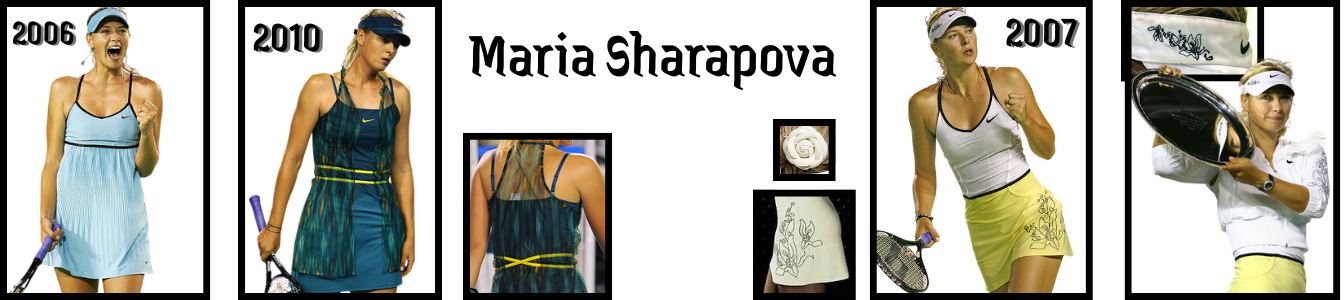
Starting off strong with Maria Sharapova, who in 2006 wore, in my opinion, one of her boldest looks. She stepped out on the court wearing an empire-waist baby doll dress in a baby-blue colorway. The monochromatic outfit was enlivened by black spaghetti straps and black borders on the upper half that cinched the bust. The micropleats on the dress give it a breeziness that complements the Australian summer.
Of course, baby-doll dresses (controversial as they were) were all the rage in the early 2000s, also known as the Y2K era, often paired with jeans. These short, loose-fitting silhouettes sparked debates about infantilization in fashion, yet dominated wardrobes everywhere. Interestingly, we have seen a revival of this style in contemporary fashion discourse, where the original narrative has been subverted. Now, reinterpreted as a symbol of empowerment. This look by an 18-year-old Sharapova feels like a youthful rebellion against tennis’s tailored aesthetic and rigid dress codes.
For 2007, Sharapova flipped the script entirely. Out went the baby-doll dress, replaced by a white corset-style cross-back top with subtle boning and black accents. She paired this with a summery lemon chiffon skirt featuring an embroidered lotus or orchid print near the hem—though I struggled to make out which flower even after studying it closely. True to her detail-oriented fashion sense, Sharapova accessorized with a matching white visor and a pale yellow flower hair clip. For the trophy ceremony, she added a white bomber jacket with a voluminous ruffled neckline and the same embroidery on the left sleeve. The ruffles, however, to me, felt awkward and unflattering. Jacket aside, against the green of Melbourne, the outfit looked spectacular.
The last look I’ve chosen is from 2010, one described by critics online as a “seaweed” and “more atrocious then the tennis displayed” and by Sharapova herself as “In hindsight, there was too much going on with this one.” Yes, it’s a shame that this, what I am calling a bespoke beauty, appeared for only one round; an idea sketched by Sharapova herself. I’ve genuinely not seen an outfit like this, a two-layered dress, on court. The base was a simple teal slip dress with a parallel yellow belt crossing at the back. It is the second layer where the magic really unfolds: A halter-neck mesh overlay. Very peacock-feather-esque in its tonality. Tacked down for performance maximisation, it added a seamlessness to the overall look with subtle ruffle detailing at the neck. Honestly, the creativity and silhouette intrigued me, and I love a halter piece, so I’m sure that is what sealed this look for me.
Next on the list are two ladies who have championships and sarotial prowess embedded in their DNA. On and off the court, they sauntered down an experimental path from the get-go, never afraid to express themselves. And, this level of boldness and aplomb delineated their entire game too.
Fashion remained their North Star, even when the game got tricky.
Serena Williams (2003, 2013, 2015)
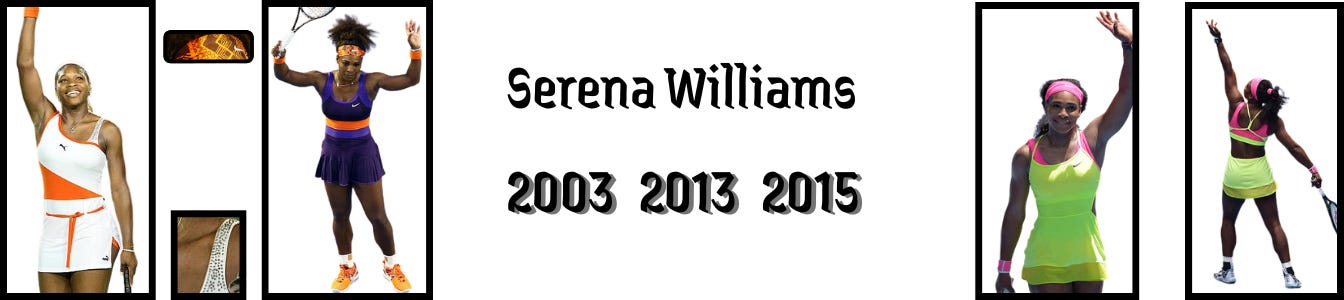
Often overshadowed by the rest of her arsenal, this short-lived Puma contract for Serena Williams was just a glimpse into the fashion storm she’d whirl us all in. We see a crisp white dress contrasted by a bold tangerine-orange panel sliced diagonally around the waist. The asymmetrical neckline added a contemporary edge with her diamond-encrusted strap. These rhinestones were hand-sewn by Williams onto her bra strap, which she then sewed onto the dress. She tied the look together with a coordinating rope belt. This 2003 look marked the completion of the “Serena Slam”, and so in retrospect, I guess for Serena, this rings true: once encrusted in diamonds, forever bedazzling in them.
2013 brought to the court a dress so deceptively simple in its look that it reeled me in. I wondered, what could be the reason? And the answer was actually simple: this is a beautifully fitted dress. The colour palette is harmonious with the deep purple and light violet radiating regality, while the vibrant orange used strategically at the bust band and accessories made for a high-impact contrast. It’s truly colorblocking at its finest. And, her thoughtful headband detailing—an African Tribal print— was her homage to February's Black History Month. What captured my attention the most was the thick waistband with all-around dense knife pleating, with my favourite detail being the light purple border on the hem that unifies the look.
Then, in 2015, in the year of fluorescence in Melbourne, Serena stood out with her rendition of it. She wore a neon-yellow cut-out dress with a racer-back cut, which popped against Rod Laver Arena’s blue. But it is the outfit in its entirety, with the neon hot pink sports bra, shorts, headband and wristbands that gives it a standout dimension. This was a dress that proves beauty and power are two sides of the same coin. And wins you your sixth Australian Open and 19th Grand Slam title.
Oh! Serena Williams, you will stay forever en vogue.
Venus Williams (2009, 2017)
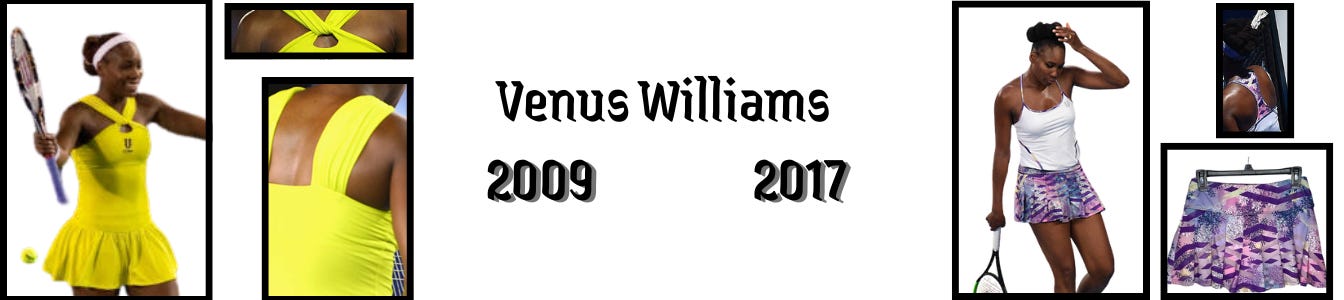
The other half of the most iconic sibling duo to ever grace the court: Venus Williams. While we wait to see what magic she’s conjuring for her 22nd Australian Open appearance, let us acknowledge that she turned pro at 14; she’s 45 now and still serving up a storm. If there’s one dress that dropped my jaw, it was Venus’s 2009 neon yellow. She’s wearing her own brand, “EleVen”. The bold X-shaped neckline steals the show, with two wide yellow straps crossing right at her chest and meeting at a little keyhole cut-out that keeps everything perfectly in place. What I love most, though, is the ruching that hugs the body in the most flattering way, adding texture and attitude all at once. And, just when things get sleek and fitted, the skirt softens things up with subtle pleats, giving her just enough flow and unforced glamour that’s totally match-ready.
In 2017, she showed off a mix of looks from her Thika Collection. For the Williams sisters showdown finals, she wore a crisp white tank top with the skirt’s pattern used on the straps and bordering the top. The same pattern also runs down the sides of the top, mimicking a corset boning. The skirt’s pattern blends purples, blues, and pinks in the same cool colour family, giving it a smooth, watercolour-like feel. Soft edges and a light speckled overlay makes the shapes flow together instead of clashing. The chevron waves move the eye, and the colours melt together for a dreamy, effortless look.
To round-up the Women’s fashion files, I’ll quickly take you through the other outfits on the list that made me stop and go, Wow!
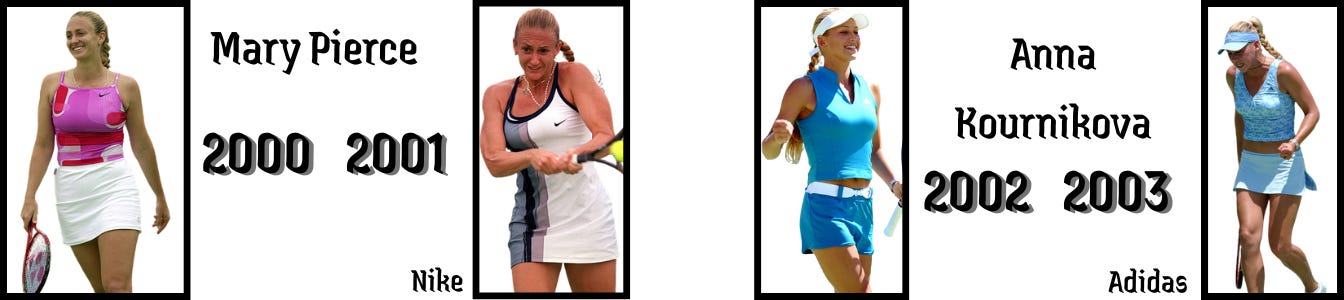
We start off with two Nike outfits.
Extremely underrated in discussions of tennis fashion, Mary Pierce flies under the radar but had such a noteworthy sense of style. Her outfits from 2000 and 2001, I couldn’t help but be enraptured by. In 2000, she wore a form-fitting tennis dress, predominantly white with vertical panels of light grey, dark grey, pale mauve, and navy blue running down the front and covering the right side. In 2001, she wore a vibrant pink-purple tank top with reds and whites that form an abstract geometric pattern, and a classic A-line white skirt. Both her looks were distinct, elegant, and made me want to add it to cart immediately.
I’m following this up with two Adidas outfits for Anna Kournikova, who probably got a legion of fans to enroll in tennis lessons just so that they could dress like her. Kournikova’s 2002 outfit can be categorized as a “cult classic.” An Aqua sleeveless racerback tank with a standing collar and V-neckline. The top stopping at the midriff was a trademark of the Russian and the early 2000s zeitgeist. She paired this with matching 1970’s-esque shorts and a wide white belt, which was the hero detail. Kournikova’s 2003 geometric maze tone-on-tone top in blues and a micro-mini skirt became one of her signature looks. The pattern is eye-catching but it doesn’t overwhelm and this keeps the look stylish. She retired at age 21 and only played professionally for eight years, but her name became synonymous with tennis fashion.
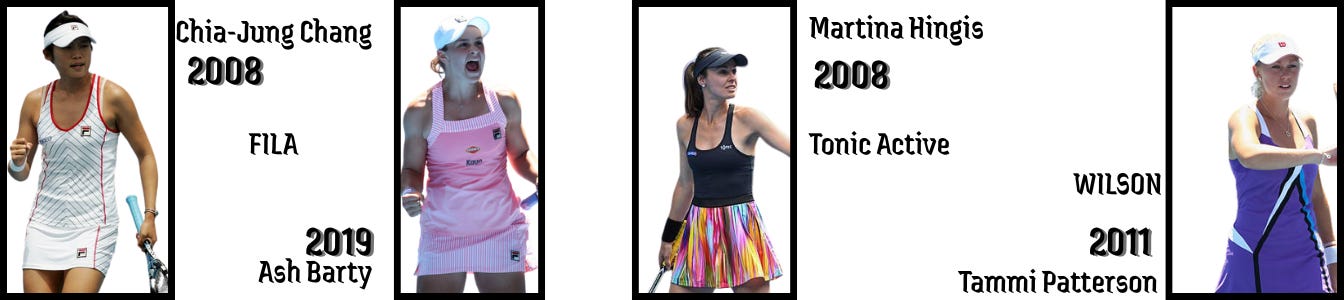
Up next is a brand that revolutionised tennis fashion in the mid-70s, 80s, and to an extent the 90s. That brand was Fila, who have now scaled back their presence in the tennis market. They became known for their signature stripes after Björn Borg famously wore them in 1975. A similar iteration appeared at the 2008 Australian Open on Chinese player Chia-Jung Chang. The look features a white top with black inverted V pinstripes and red piping as the accent. The skirt’s centre is solid white while the sides have diagonal pinstripes. The red piping adds structure and elongation, guiding the eye while unifying the striped and solid panels. By balancing these elements, the design prevents pattern fatigue, clearly defines opposing areas, and keeps the overall look streamlined and deliberate.
And, of course, speaking of FILA, I had to include my favourite Aussie Ash Barty, without whom the tour does feel a bit empty. Her 2019 look saw the Italian-South Korean brand make a rare step into the baby pink colorway. Fila and stripes have always been a love story, and this pink is the beautiful result of that romance. Simply lovely!
At the 2017 Australian Open, Swiss legend Martina Hingis took to the court wearing a Canadian activewear brand, Tonic Active, debuting their spring collection. In my selection from the line, Hingis wears the “Backhand Dress.” The standout element is a vibrant, multi-colored brushstroke abstract print that bursts with every colour imaginable. From bold reds and magentas to yellows, oranges, blues, purples, and greens. A look bursting with so many colours can easily come off as tacky, but this skirt completely avoids that trap. Perhaps it is the plain black upper half and mesh detailing at the waist that saves it.
Lastly, Wilson’s 2011 piece, worn by Australian Tammi Patterson is one I find just as intriguing today. A purple dress with white, sky blue, and black stripes running from the middle down in a shape close to a triangle. And, guess what, almost two decades later, Wilson is still finding ways to surprise and delight. Cupid seems to have struck the brand this time around, as they shoulder the hopes (and expectations) of athletes and fans alike with designs that are as versatile as they are stylish.
In this next archival section, we will make a quick stop to go over some of the men’s looks.
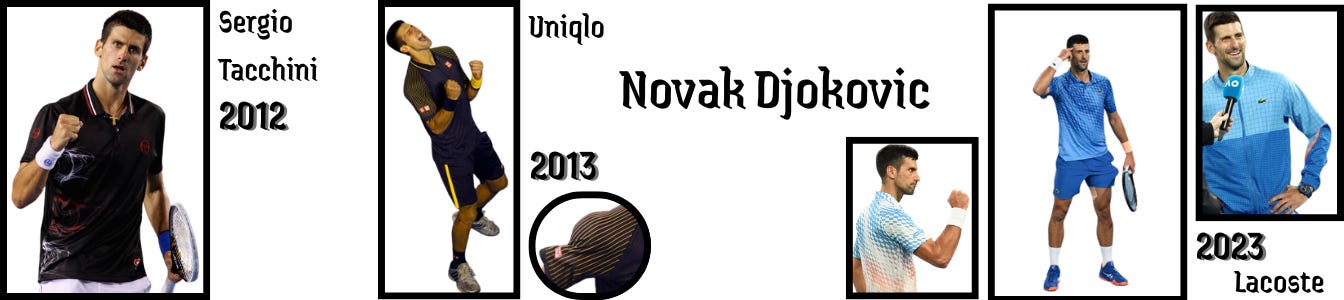
Novak Djokovic (2012, 2013, 2023)
First, we have three interesting outfits Novak Djokovic has donned in Melbourne, from three different partnerships: Sergio Tacchini, Uniqlo, and Lacoste.
With Tacchini, the outfits were bold and blazing, with a dragon theme dominating some of them. Especially fitting for his 2012 AO victory against Rafael Nadal: a time-honoured battle. Here, he wore a black outfit with a swirly white-red-white trio on it, oddly and vaguely reminiscent of Ed Hardy minus the rhinestones. (There was a white colorway too which I didn’t really like). A shake-up came with Uniqlo, which felt like the complete opposite with their simplistic and minimal kits. An entirely overshadowed era, but this 2013 Uniqlo kit worn by Novak Djokovic is, in my eyes, one of his best outfits. The Midnight navy colorway and taxi yellow pinstripes on his shoulders and bordering his collar looked spiffy and well-suited for a title defence. (Oh, and I really like pinstripes as a print, so this makes it even prettier!)
Then came Lacoste, who snagged a balance between both minimal and expressive kits, culminating in some of his career best ones. I wasn’t planning on this segment going anywhere beyond 2019, but for the King of Melbourne, an exception can be made. His 2023 outfit, in which he won a record-shattering 10th AO title, is hands down the coolest one. Both colorways, a blue-on-blue pixelated one and a white with blue pixels fading into a soft coral, created a nice-looking gradient. The on-court jacket, too, was strikingly stylish with a subtle geometric grid pattern enhanced by a light-to-dark blue.
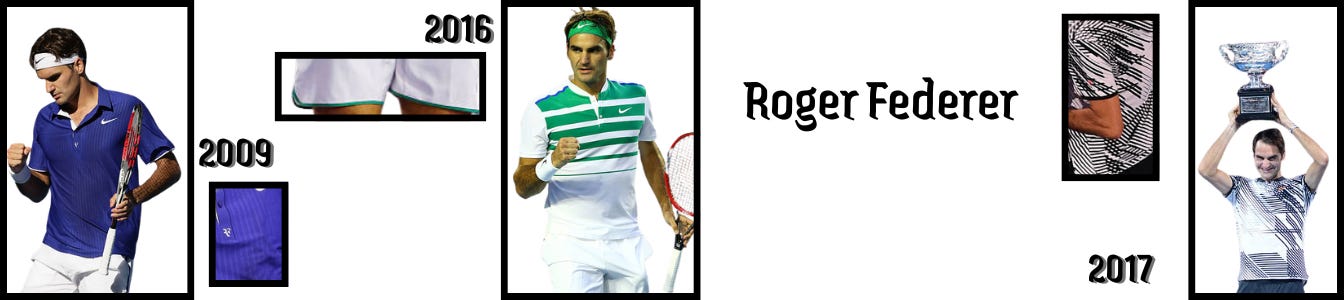
Roger Federer (2009, 2016, 2017)
A Fashion conversation without Mr. Swiss? No chance. Ladies and gentlemen, the man synonymous with insouciant elegance, Roger Federer. All 3 looks that I’ve chosen are from his time with Nike. In 2009, he sported a traditional royal blue colour t-shirt with white shorts and a blue stripe running down the sides. It’s a very minimal look, with subtle vertical stripes, but I love how electric this colour is, and it looks princely on Roger. Next up, 2016. One word to describe it would be: sharp. A white t-shirt with medium spring green horizontal block stripes and a diagonal blue stripe at the shoulder. But it’s the detailing, the green piping at the shorts hem, that elevates this look and gives it that zing factor.
Moving on to 2017. It was historic not only because Federer came back from knee surgery to win in a resplendent manner but also because he wore graphics! A massive shift from his usual minimalism. This outfit saw a tridirectional abstract stripe pattern in black on a white base with just a pop of orange from the Swoosh logo. With this look, of course, he looked poised to win his fifth Australian Open title.
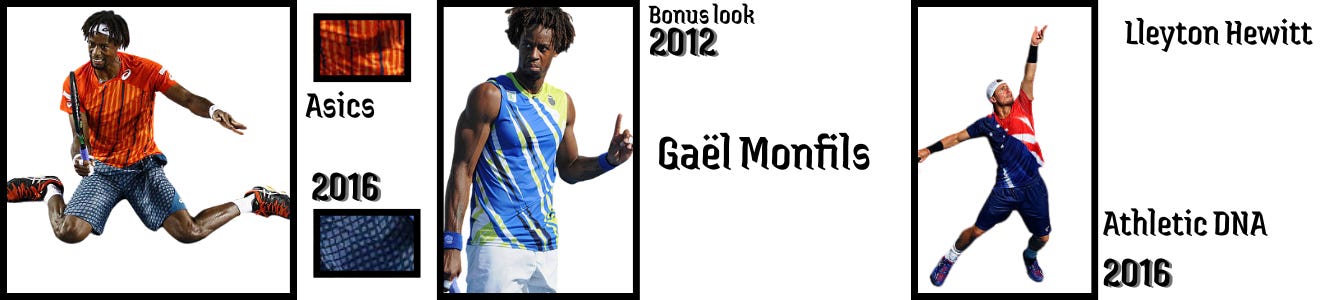
Gaël Monfils (2016)
I had to give a special shout-out to the man who made tennis incredibly exciting to watch: Gaël Monfils. His electric energy, charisma and athleticism will be missed on the court as he begins his farewell tour. I thought no one could convince me to appreciate discordant patterns with the t-shirt and shorts being starkly different, but this man did. In 2016, sporting Asics, Monfils wore juxtaposed patterns with vertical stripes on his vibrant orange t-shirt, pairing it with a geometrical grid pattern on his blue shorts. And, fun fact, he made it to his best showing in Melbourne with a quarter-final whilst rocking this. Call it a pattern overload, or overkill, but absolutely nobody on the Tour can dare to even rock it the way he did.
To put it plainly this means: There never can or will be another Gaël Monfils!
We cannot wrap-up without an honorary Aussie mention on the men’s side. This goes to Lleyton Hewitt. His 2016 farewell look saw him wrapped in a t-shirt designed by Athletic DNA, an American company, to depict the Australian flag. No better tribute than this to the Rod Laver Arena that he called home!
For this edition, I’m going to have to skip out on Nadal and Murray, since it’s running long. But in case you were wondering, I had picked Nadal’s 2008, 2018 and 2019 kits, and Murray’s 2014 night kit and 2019 kit.
I had also bunched up some 90’s fashion where oversized tees swept the field. But that definitely deserves a separate post to honour the era!
So, dear reader, if you made it this far then thank you very much for reading! With this, we wrap up our Melbourne archival chapter. And here’s my biggest takeaway: Every season felt different, and you could tell them apart.
I also realised through this excavation that the power of fashion truly lies in being your own unfussy muse.
And this would also be my takeaway for the current scene of tennis fashion. A player’s on-court style affords us glimpses into their personality, especially when custom elements come into play. And this quest to showcase parts of oneself is something we’re seeing on the rise right now, with a shift in the market from heritage, big-name brands to newer entrants who offer enticing opportunities to take to the court and do it the player’s way. Because the devil, after all, dear reader, lies in the details :)
I’m sure there’s a plethora of looks that missed the cut, or those that I am unaware of, but if you have any to add from your list of Australian Open favourites, then please do drop them in the comments!
I hope you stay unapologetically stylish and turn the world into your runway.
Until Next Time,
Love,
Areyah
Author’s note: My newsletter—Love.All— is fully reader supported. If you have enjoyed reading my work and would like to see more, then please do feel free to click on the link below. Thank You <3
https://www.tennisforum.com/threads/lili-de-alvarez-spains-first-great-tennis-star.390808/
https://www.thenewworld.co.uk/brexit-news-europe-news-lili-alvarez-the-campaigner-of-wimbledon-centre-court-8106640/
Loved reading this piece! Federer's on-court fashion will always be the peak for me!
An ultimate read indeed. The way you move from Schiaparelli’s early influence to Serena and Sharapova makes tennis history feel so alive and fashion led. Such a refreshing way to look at the Australian Open🤍