

February Blues
A month long whirlwind.

Dearest Reader,
Does this only happen to me, or does January’s “I’ve got this year” momentum give way to exhaustion rather quickly and tiresomely? Because this is how February has been for me: an-injury-riddled-all-I-want-to-do-is-sleep-but-also-trying-to-make-the-most-of-it-all episodic drama. To add to my concentration woes, Tennis’s unforgiving scheduling was on full display.
Globetrotting, while it sounds exciting, if you’re a tennis fan, has you questioning your sanity. I’m serious, February does feel like an outlier on the tennis calendar. The shortest month of the year shoulders the burden of keeping tennis rolling and alive after its Australian departure. If you can keep up with the UAE, Czech Republic, Romania, Qatar, France, Netherlands, Argentina, Brazil, USA, Mexico, Chile, and oh, the Davis Cup qualifiers that cover all these places and more, then congratulations, you’ve just won a gold at the mental CrossFit.
I’m convinced that I need to harness the superpowers of Mrs Incredible’s superelasticity and her baby Jack-Jacks teleportation and self-duplication to cover all of this and sustain throughout the year. (Ah!! How I wish I could be on site, instead of four walls— maybe someday soon)
Before we move on, I wanted to thank you for being here. On 24th February, I celebrated a year of Love.All! This little baby, sprung out on the tour intrigued by Sampras and sipping pina coladas on Californian beaches, then turned the courts of Europe into her very own playground, rolling around till she’s one with the clay; found her Platform 9¾ on Wimbledon’s centre court, all while bracing the unfavourable English weather. Only to be gifted with a traumatic dose of doubles slander and Alcaraz’s buzz cut. Unexpectedly and gloriously, she was saved by the Agassi-Mania at the Laver Cup and then found her stride as she channelled her inner Miranda Priestly. Through all these iterations, as she learned how to stand on her own two feet, you’ve been patiently watching it all unfold. From the bottom of my heart, I’m enchanted and grateful. Onto year 2 and hopefully interactions with many more of you <3
On this note, can we also please pretend that this newsletter arrived promptly and punctually in your inboxes on the 28th of February? Okay, thanks.
Cameragate
We all love tennis. We all want to see it thrive. But do we truly care about the people who make this game come alive?
At the Australian Open, there are cameras everywhere. Hallways, warm-up zones, corridors; almost every corner is covered, and thankfully, the locker rooms are out of order. Yes, it’s imperative for the safety of everyone on site. Yet, when footage is constantly being publicly released, it crosses the threshold of respectability and escalates into an encroachment of privacy. This year, after Coco Gauff (USA) lost her quarterfinal match (1-6, 2-6) to Elina Svitolina (Ukraine), she was disappointed and distraught, and rightfully so. To let off some steam, she wandered into a corridor, which she presumed was off-limits from the watchful gaze of the camera. Unfortunately, the broadcasters televised her racket smashing.
In her post-match press conference, she shared:
“I tried to go somewhere where they wouldn't broadcast it, but obviously they did. So, yeah, maybe some conversations can be had, because I feel like at this tournament the only private place we have is the locker room,”
Gauff confessed that she smashed her racket to avoid misdirecting her anger towards her team. She also added that she refused to break one on court since it is “not a good representation”. A similar incident transpired at the 2023 US Open finals, where Aryna Sabalenka lost to Gauff in the finals. Here, the cameras shadowed her path to the locker rooms, where in the corridor she smashed her racket and chucked it in the bin.
Two deeply vulnerable moments on different grounds, yet the same outcome: aired for everyone’s consumption. Beyond this, what must also be counted as disturbing are the stills: sometimes it is of a player simply lying down before their match, other times it’s players using their phones, which is then being zoomed in on to see.
In 2019, multiple cameras were first installed at Melbourne Park to capture all the happenings as they unfolded in real time. Here, too, a deeply personal moment of Petra Martic (Croatia) dropping to the ground after a third-round loss was on display. Or the viral moment, that year, where Roger Federer forgot his accreditation and had to wait out. While this might seem innocuous, Iga Swiatek (Poland), this year, rightfully pointed out, “It’s not our job, like, to be a meme when you forget your accreditation. It’s funny, yeah, for sure; people have something to talk about. But for us, I don’t think it’s necessary.”
In response to all concerns, the Australian Open put out a statement offering to review the feedback to ensure a better solution moving forward. [You can catch more details on Bounces by Ben Rothenberg]
I also read about the ATX Open in Austin, Texas, launching a rage room. The WTA 250 tournament’s attempt at providing a safe, camera-free zone where they could just smash their frustrations away. Comical as it sounds, it might prove beneficial for some, and maybe to balance things out, have a zen arena, for those not interested in participating in the rage.
I keep wondering about how desensitised we’ve all become in the face of rampant social media consumption to the extent where we look at anything and everything as “content”. The constant inflow of tiny “soundbites” has become the norm and is only encouraged with complete disregard for the consequences whatsoever. Doesn’t this feel off the rails? Moreover, there’s almost a sense of entitlement that seeps into the air. One where you have an itch to know what’s happening with whom and where. This is a result of parasocial relationships. By definition, ‘Parasocial relationships (PSRs) are nonreciprocal socio-emotional connections with media figures such as celebrities or influencers.”
Even the untrained eye can see how this insidiously pervades everyone’s lives. When you conjure dispositions of people in your mind, and the reality is far from rosy, you end up lashing out, and an outpour of toxicity and abuse follows suit. If someone is willing to share parts of their life, then respect that; and if not, then respect that too. You put people up on a pedestal; they didn’t ask to be there.
Speaking of sharing parts of your life, with the camera discussions open, it feels a little hypocritical that tournaments can display every second of their life, but players cannot share their own match clippings.
It is not as complicated as it seems. How would you feel if you were being constantly watched? Surveilled rather. Inevitably, paranoia and anxiety would creep up on you, and every waking moment becomes inhibited by a pulsating tension about your whereabouts, one that is hard to shake off. Sounds eerily dystopian, doesn’t it? The first time I read such a novel was as a kid, “The Giver” by Lois Lowry, a dystopia masquerading as a utopia. A few more books that entail different kinds of dystopic set-ups and premonitions include, famously, 1984 by George Orwell; The Memory Police by Yōko Ogawa; Farenhite 451 by Ray Bradbury; I Who Have Never Known Men by Jacqueline Harper; The Trial by Franz Kafka; and The Circle by Dave Eggers. (Please give them a read, and if you have any more along similar lines, then do share them!)
Wait, as I’m typing this, a thought arose, is it not crazy how we used the words “future” or “futuristic” to describe hellish scenarios of robots taking over, and cyberwarfare and more, and flash forward to today, and all this and more is dictating our being?
Alright, back to tennis.
Tennis thrives on visibility, but it doesn’t need to live under a microscope. And while mass media networks keep the sport on an upward trajectory, there’s a fine line between coverage and overexposure. Yes, keep the cameras rolling for safety and for storytelling— just don’t turn every little corner into a primetime drama zone. A little discretion would do everyone good! :)
5-setters for women
To play, or not to play, that is the question.
After Australian Open tournament director Craig Tiley (recently named USTA CEO) briefly broached the subject, showing an inclination towards the WTA players playing five-setters, but only from the quarterfinals onwards, there has been a slew of opinions on this matter.
If you, too, have ever wondered why the women never played the same format to start with, then you should know the answer is deeply rooted in misogyny and sexism. But are we surprised?
In the late 19th century, women actually played Bo5 sets. From 1891 to 1901, at the US National championships. However, in 1902, an all-male council decided to reduce it to three sets because five sets were deemed “too strenuous for the weaker sex”. Since then, it has been an uphill battle for all women every time this subject has appeared. More unforgivably, this unilateral decision is ceaselessly used as a weapon against them.
Around 70 years later, in 1973, trailblazer Billie Jean King played the historic ‘Battle of the Sexes’ against Bobby Riggs and insisted it be a best of 5 format. King didn’t need the full 5 sets to be crowned Queen; a straight sets 6-4 6-3 6-3 scoreline did the job.
You’d assume that this resounding victory would catapult five-setters into the women’s tennis sphere, right? Yet, no major tournaments were on board. The ITF remained obstinate in their decision.
A decade later, between 1984 and 1998, women played the best-of-five in the finals match at the WTA Tour Finals. Because sometimes you’ve got to grab the reins when everyone around you seems hell-bent on staying static. Short-lived but an important marker in women’s tennis.
Currently, this entire discussion is like traversing muddy waters, because, hypothetically, if you green-light the Bo5, then the entire structuring of the tour will have to be upended. In a climate where 250s and 500s are already at risk of ceasing to exist, despite their ubiquity now, this would be the final nail in their coffin. Logistically, the question of feasibility and revenue comes into effect if the Slams get extended. It would be almost a month of play and exhausting on-site for everyone involved.
If you choose to extend it from only the quarterfinals onwards, it still is inequitable. Switching formats in the middle of a tournament sounds ridiculous as it is. Plus, it’s unfair to the overall playing field. Perhaps someone who got knocked out in straight sets in R1 could have mounted a comeback to win in 5 if it were established from the start.
Most importantly, are the players willing to play in today’s conditions? When the scheduling is already stretching you too thin. Some players, like Aryna Sabalenka and Coco Gauff, have admitted they would benefit from the longer format, citing physicality as an advantage. Though Gauff did note that only if the entire tournament was Bo5 would it be fair. Other players like Elena Rybakina, Iga Swiatek and Jessica Pegula are not proponents of this newly proposed format.
Swiatek’s response: “I don’t know if we would be able to keep the quality for five sets. Men are more physically strong and they can handle it better. She also went on to say that, “Also, we have never practiced in a way to prepare for that, so we would need to change our whole calendar, because the Grand Slams would be so tough that I don’t think we would have time to prepare for any other tournaments.”
Rybakina;s response: “You start in one format, and then it gets longer, so mentally, to be ready to play so many sets if it goes to that point, I think it’s not easy,” She added, “It’s a tricky topic, and me, as a player, I would say I wouldn’t want to play three out of five, to be honest.”
I don’t agree with the first half of Swiatek’s statement. Otherwise, they’re both fair in their overall assessments.
Jessica Pegula is the chair of the new 13-person Tour Architecture Council and has played an active role on the WTA players council. She expressed that she is not a fan of the Bo5 contest in general because of how lengthy and exhausting the matches can be. In a sport like tennis, where the start and end times are non-existent, if you added women’s Bo5 into the mix, you could very well have only 2-3 matches in a day. Pegula also set the record straight, shutting down any naysayers who believe women cannot play the Bo5,"There are fantastic athletes in the women's circuit right now, and I think we could play five sets, but it's not necessary… [and] I don't think it would be positive for tennis.”
As a fan, would I love to see the women play Bo5? 100%. But I don’t have to lift a finger. The decision should rest solely with the players, with all subsequent actions flowing from that. Wait, no, sorry, my bad, I think the decision rests with the ITF— the governing body of the Slams. They didn’t agree when it was being rallied for in the 80s; I highly doubt that stance would change now.
Serena Again?
Moving on to the most-awaited reveal for tennis fans across the globe: will Serena Williams make a return to the tour? While I haven’t followed the entire saga/speculation avidly, it has piqued my curiosity. I vividly remember watching Williams take on Ajla Tomljanovic at the US Open in 2023 for her farewell match. Of course, her gorgeous outfit still catches my eye, two years on.
As of February 22, 2026, Serena Williams is officially eligible to make her return to tennis. Andrea Petkovic pointed out that, “You don’t put yourself in doping protocols unless you really want to return to play singles.” Now, Serena has been teasing fans through her Instagram posts, and it’s all a little game of cat and mouse, for now. I love Serena and I think this would be mind-bending if it were to happen. Realistically, maybe not singles, maybe she comes back for a last dance doubles with Venus? But it’s THE Serena Williams, and I would not make the rookie mistake of counting her out :) (Wimbledon and Williams is a love story too…)
A few more thinking out louds:
This just had to be the first. The ATP500 Rio Open having ball dogs!! Ahh its always too cute. The intiative by PremieRpet's (a Brazilian company committed to enhancing pets' quality of life and protecting the environment) was to encourage responsible pet adoption. This began in February 2016 at the Brazil Open in São Paulo, where four rescued dogs (Frida, Mel, Isabelle, and Costela) were trained to act as ball dogs. Only to see more of this, I’d convert the Rio Open into a M1000, a 2-week one…oops.
Goran Ivanišević is back. This time with Frenchman Arthur Fils, who had been out for almost 9 months after an excruciating lower-back injury in June 2025. Since leaving the Djokovic camp, it was highly anticipated by many to see who Ivanišević would coach next. The success that he’s enjoyed with the 24-time major champion is quite hard to replicate elsewhere. But, I didn’t think I’d see a coaching roulette here.
From December 2024 to January 2025, we saw a short-lived trial partnership with Elena Rybakina, who was in the throes of having her coach, Stefano Vukov banned. Ivanišević, unfortunately, got caught in this crossfire between Rybakina and the WTA. Then, in May 2025, he joined hands with Stefanos Tsitsipas. The Greek, who has been in a slump for a while now, rejuvenated hope’s when he decided to hire Ivanišević, especially with Wimbledon around the corner. However, just two grass-court tournaments in and this partnership had already run its course, after Tsitsipas retired against Valentin Royer in R1 of Wimbledon. A very messy breakup with what feels like a constant reciprocal vituperation. (okay, no, maybe vituperation is a tad too dramatic… maybe mutual badgering sounds leaner?)
I am excited to see how Fils and Ivanišević work together. Did this pop up unexpectedly for me? Yes. Fils already possesses a lethal forehand with a massive top-spin. With Ivanišević’s speciality being the serve, I think it is only a matter of time before Fils starts to develop a deadly serve +1 combination. At just 21 years old, Fils has already displayed flashes of brilliance, and health permitting, he is poised to refine his skills and mold himself into the player he hopes to be.
Britain’s number one, Jack Draper, too, is back in action. At the Davis Cup, he made a victorious comeback against Norway after being absent from the tour for 6 months. He then immediately withdrew from the tournament in Rotterdam, raising questions around his physicality and recovery. Draper then made it to Dubai and won his first round against Quentin Halys in straight sets. While beating Arthur Rinderknech was going to be a tough ask, he pushed the Frenchman to three sets— steady and positive signs indeed. Now, defending his title at Indian Wells will be a massive undertaking, but it’d be interesting to see how far he can go during his comeback phase.
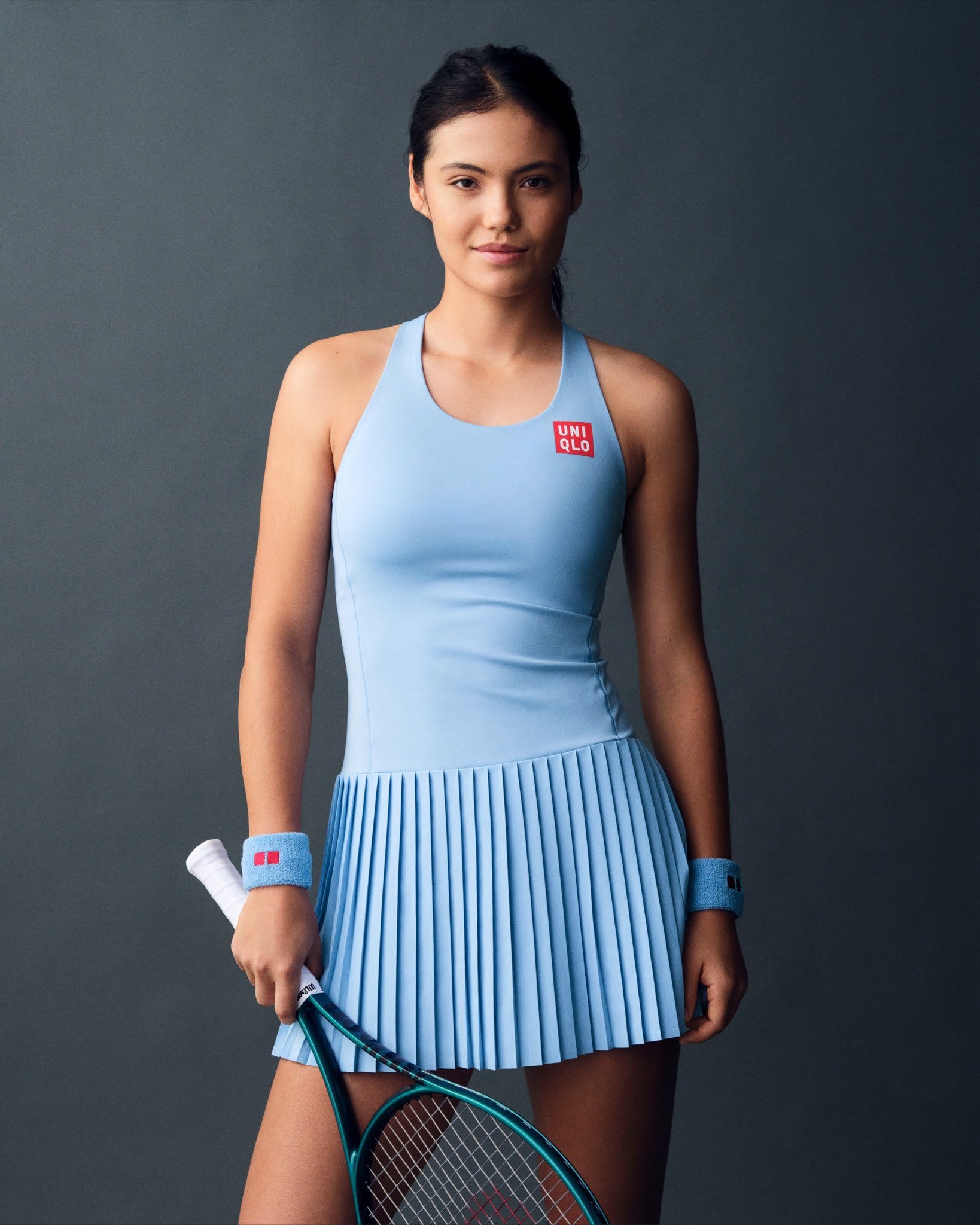
Emma Raducanu signs with Uniqlo. This sponsorship news was first revealed by Craig Shapiro in December 2025. The figures are estimated at $3.5 million per year plus performance-based bonuses. This also marks Uniqlo’s first foray into women’s tennis. Only the crème de la crème of tennis have donned Uniqlo thus far: Roger Federer and Novak Djokovic. That is some legendary company already. Hey, maybe this new sartorial deal brings her some luck? And the first look of her outfit is a gorgeous baby-blue colourway with sharply defined pleats.
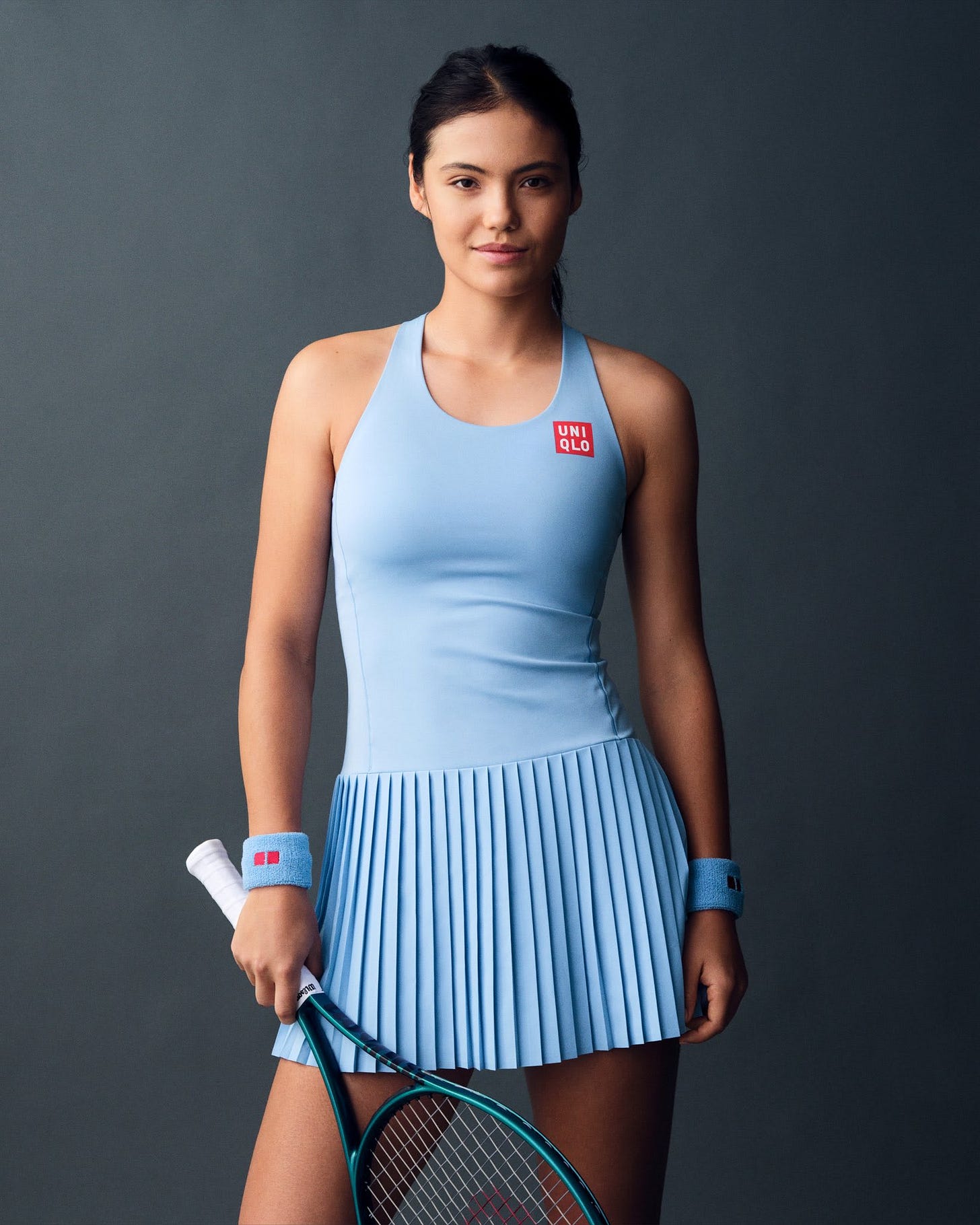
Raducanu in Uniqlo’s announcement post. In other news, Carlos Alcaraz got a haircut. Again. A mullet/wolf-cut this time around. I’m kind of envious of just how fast he can grow a full head of hair. Perhaps, this is his real superpower; it is what affords him confidence and creative liberties.
And with this, dear reader, the first ATP M1000 and 3rd WTA M1000 of the year, Indian Wells, starts today. This kicks off the Sunshine Double Swing. One that is eagerly awaited by players and fans alike. The time zone is going to be a nightmare for me to deal with, since matches start at 12:30 am IST. At best, I watch the first and last matches of each day. I’m going to try and work this out.
Every time I think each post will be short and brief, I end up with a dissertation.
And as always, I thank you for reading and being here!
Love,
Areyah
Author’s note: My newsletter—Love.All— is fully reader supported. If you have enjoyed reading my work and would like to see more, then please do feel free to click on the link below. Thank You <3
In the meantime, you can check out my new post:

february felt like 6 months of tennis crammed into 28 days, and this newsletter somehow kept up with all of it. happy first birthday love.all🤍
So interesting about a rage room being secured....those poor rackets. What did they ever do?! It's user error in my mind. Anyway, great article. Got back into following tennis after a long hiatus. I guess seeing Alcaraz play in person at Roland Garros (3rd round viewing, but still) can do that. Cheers